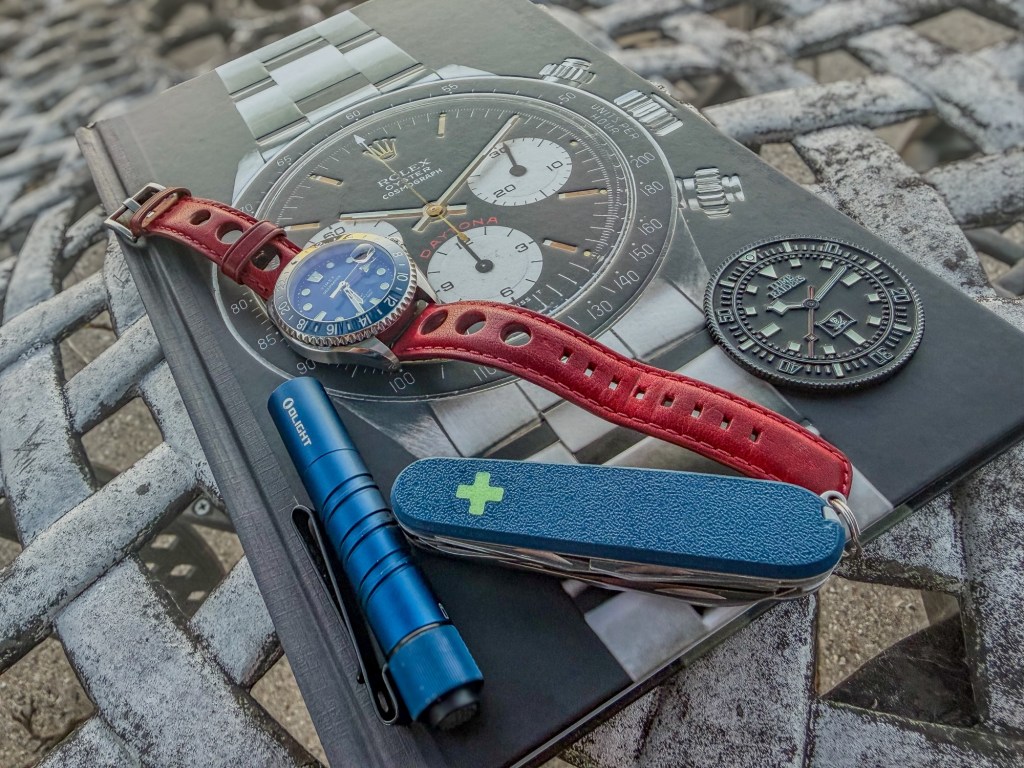
The Expedition Pioneer and Deepwater Meridian GMT show just how far Timex has come—and where there is still work to do.
Jordan
Land Diver Society
I have had two Timex reviews sitting in the backlog for longer than I really wanted: the Expedition Pioneer Automatic and the Deepwater Meridian GMT. I had every intention of giving both of them their own full final reviews. I wore them, tested them, took notes, and did everything I normally would before sitting down to finish an article.
Then I just kept not finishing them.
Other watches came in. Other gear was more interesting to write about. Other articles kept moving ahead of these two. Eventually I realized there was probably a reason for that. Neither watch really needed another full standalone article from me.
That does not mean either one is bad. Actually, I think both are good watches. More importantly, after spending time with both of them, I think they tell a much more interesting story together than they do separately.
Timex is making some genuinely good enthusiast watches right now. The company is moving beyond the inexpensive, accessible watches most people associate with the name and putting out watches with sapphire crystals, ceramic bezels, automatic movements, serious water resistance, GMT complications, and prices that put them into increasingly competitive territory.
The fundamentals are there. What I keep finding, though, is that Timex is sometimes one or two details away from turning a good watch into a really damn good one.
These two watches are probably the best examples of that.
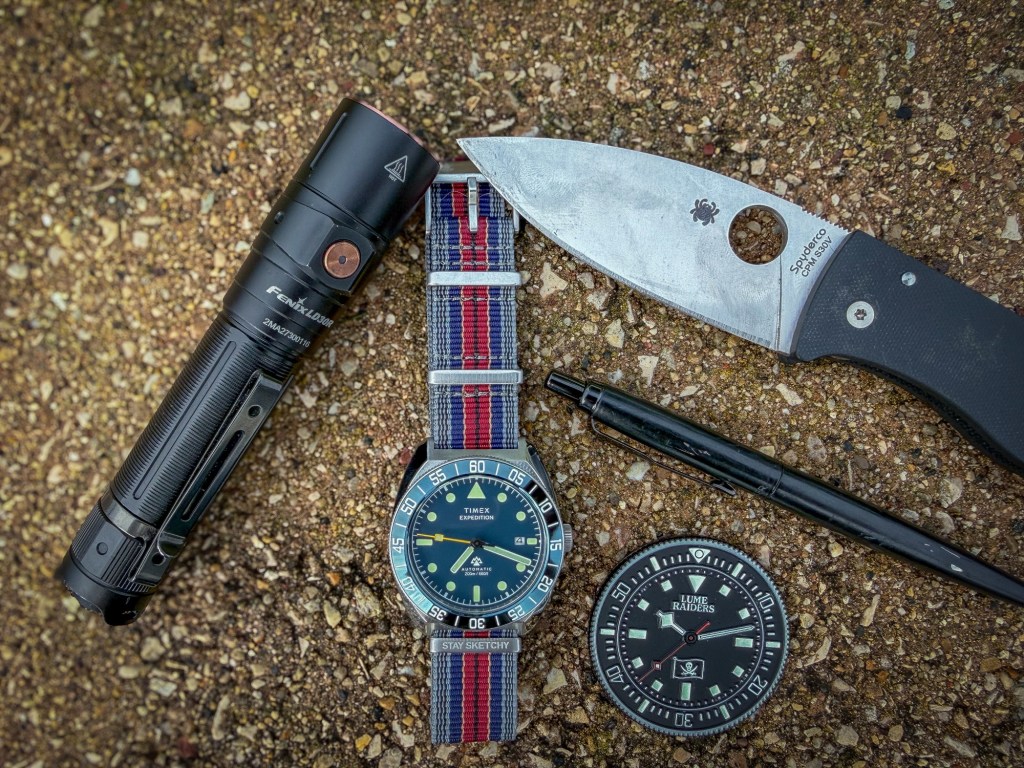
The Expedition Pioneer Automatic
The Expedition Pioneer was the less expensive of the two at $429, and strangely enough, I think it makes the stronger argument for itself.
When I first opened the box, I was a little disappointed. The watch I received did not quite look like the watch I thought I had ordered. Timex’s product photography makes the bezel appear like a much brighter greenish-blue or teal. In person, that color is considerably more subdued and can look nearly black depending on the lighting.
That remained one of my biggest annoyances with the watch. The actual bezel color is not bad. When the light catches it correctly, it looks good. The problem is expectation. If I wanted a black bezel, I could have ordered a black-on-black watch.
Once I got past that, though, there was a lot to like.
The Pioneer is a weird watch to categorize, and I mean that in a good way. Timex does not really present it as a traditional dive watch, and visually it has plenty of Expedition DNA. At the same time, it gives you 200 meters of water resistance, a screw-down crown, timing bezel, sapphire crystal, and ceramic bezel insert.
I ended up thinking of it as a field-style dive watch. It has legitimate dive-watch capability without looking like every other traditional diver.
At 41mm with roughly a 48mm lug-to-lug and 20mm lugs, it also wears extremely well. It feels closer to a traditional 40mm watch on the wrist than the dimensions might suggest. The case is comfortable, nicely weighted, and finished better than I expected for the price.
If I were changing anything about the case, I would probably tone down some of the polishing. There is nothing wrong with the execution, but for something living under the Expedition name and carrying this much actual tool-watch capability, I think more brushing and less shine would fit the personality better.
Mechanically, my example performed well. It ran at roughly +8 seconds per day during my testing. The crown was easy to use, winding felt good, and I never noticed any annoying rotor noise.
The bezel action itself felt positive, but the bezel was easier to move than I would prefer. It could get knocked out of position. For normal everyday wear, that probably means very little. Once you give a watch legitimate dive-watch specifications, though, I start judging some of those details more seriously.
Lume was another weak point. It works. It is usable. It just is not particularly impressive, especially on a watch with this level of water resistance and dive capability.
Still, none of those complaints killed the watch.
The dial is legible, the yellow hand gives it some personality, the 20mm lug width makes strap changes easy, and the overall package feels much more capable than the price might suggest. At $429, sapphire, ceramic, 200 meters of water resistance, a screw-down crown, and an automatic movement make the Pioneer a hell of a contender.
My original conclusion was that I would buy it, and that has not changed.
The Pioneer did not stay permanently in my collection, but that was not because it failed. Another watch I had missed owning had an opportunity to come back into the collection and something had to give up the spot. Sometimes that is just collecting.
A good watch does not have to become a permanent watch.
The Deepwater Meridian GMT
The Deepwater Meridian GMT is where this gets more interesting.
I have said before that dive watches are probably always going to be my favorite style of watch, but a GMT is more useful in my actual life. I regularly have reasons to track another time zone, whether that is friends and family, overseas vendors, Zulu time, or travel. It is one of the few complications I routinely use instead of simply enjoying because it is there.
So a Deepwater GMT made a lot of sense to me.
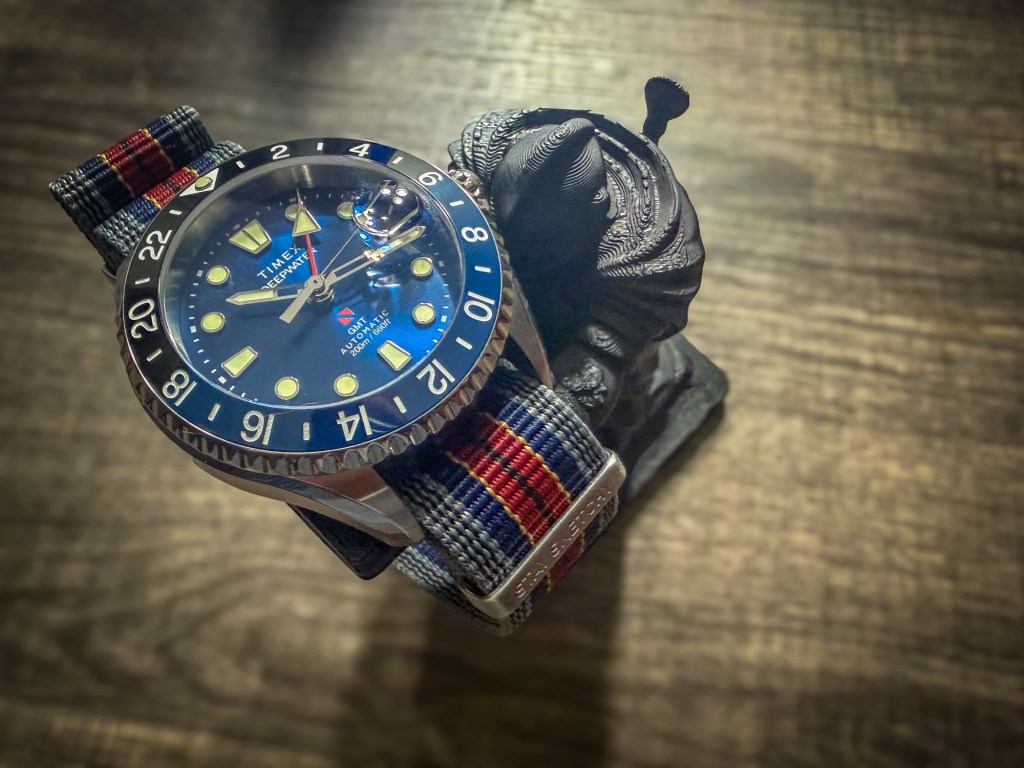
For $549, the Meridian gives you a 42mm automatic GMT, sapphire crystal, ceramic 24-hour bezel insert, 20mm lugs, and a Jubilee-style bracelet. Mine was the black-and-blue Batman version.
There is a lot I genuinely like about this watch.
The dark blue dial is one of its strongest features. The red GMT hand is extremely easy to distinguish from the main handset, and the GMT function worked exactly the way I needed it to throughout my time with the watch. The case finishing is good without becoming overly shiny, and the ceramic bezel insert held up without showing scratches.
The bracelet also surprised me. I am not much of a bracelet person, but the smaller links articulate well and make the watch comfortable. I still dislike the butterfly clasp, especially because there is no micro-adjustment or diver’s extension, but the bracelet itself is better than I expected.
Then there are the 20mm lugs. Thank you, Timex.
That sounds like a stupidly small thing to praise, but it means the Meridian can move easily between leather, NATO, sailcloth, rubber, and whatever else you want to put on it. For someone like me who changes straps regularly, that matters.
Unfortunately, the Meridian also has a collection of little problems that become harder to ignore because it costs $549.
The lume is acceptable and nothing more. The cyclops still does absolutely nothing for me. The case could lose a little thickness and weight. The butterfly clasp needs adjustment. The red arrow Timex put on the crown instead of normal crown signing makes no sense to me.
And then there is the bezel action.
It is piss poor.
That was the part I became less forgiving about the longer I owned the watch. The 24-hour bezel itself is useful, it is bidirectional, it clicks rather than relying on friction, and the alignment on my watch was good. The actual mechanism just feels rough and cheap compared with the rest of the watch.
That is especially frustrating because I have handled other Timex watches with better bezel action. Timex clearly knows how to do it better.
My Meridian also went from running around +7 seconds per day early in testing to averaging closer to +15 seconds per day over the longer review period. That is not amazing, but it is still something I can live with in this type of automatic watch. Timex does not identify the movement manufacturer, and I am not going to pretend I know something the company has not confirmed.
The movement worked. The GMT worked. The watch was reliable.
The problem with the Meridian is not that anything fundamental is wrong with it. The problem is that at $549, all the little details start adding up.
Where Timex Is Right Now
That is ultimately why I think these watches make more sense discussed together.
The Expedition Pioneer and Deepwater Meridian GMT are not really examples of Timex failing. They are examples of Timex getting close.
The Pioneer is the easier watch for me to recommend because at $429 its strengths outweigh its weaknesses pretty comfortably. I can complain about the lume, the loose bezel, the amount of polishing, and the misleading bezel color in the product photography while still looking at the total package and thinking the value is there.
The Meridian is different because Timex is asking another $120 for it and moving into a part of the market where I become considerably less forgiving.
At $549, I start caring more about the rough bezel action. I care more about the mediocre lume. I care more about the clasp, the thickness, the weight, the cyclops, the weird crown decoration, and even the same basic Timex packaging used for much cheaper watches.
None of those issues alone ruins the Meridian. Together they make it feel like a watch that needed one more round of refinement before release.
That is also why I do not think Timex needs to reinvent either watch.
The foundation is already there.
Give the Pioneer stronger lume and a more secure bezel. Maybe brush more of the case. Most importantly, make sure the product photography actually represents the color people are going to receive.
Give the Meridian a smoother bezel mechanism, better lume, a better clasp, slightly less thickness and weight, and clean up a few of the weird design choices. Suddenly you have something that becomes much harder to argue against at its asking price.
I originally wrote that Timex was about one round of refinement away from having something excellent with the Meridian. After looking at these two watches together, I think that statement applies more broadly to what Timex is doing right now.
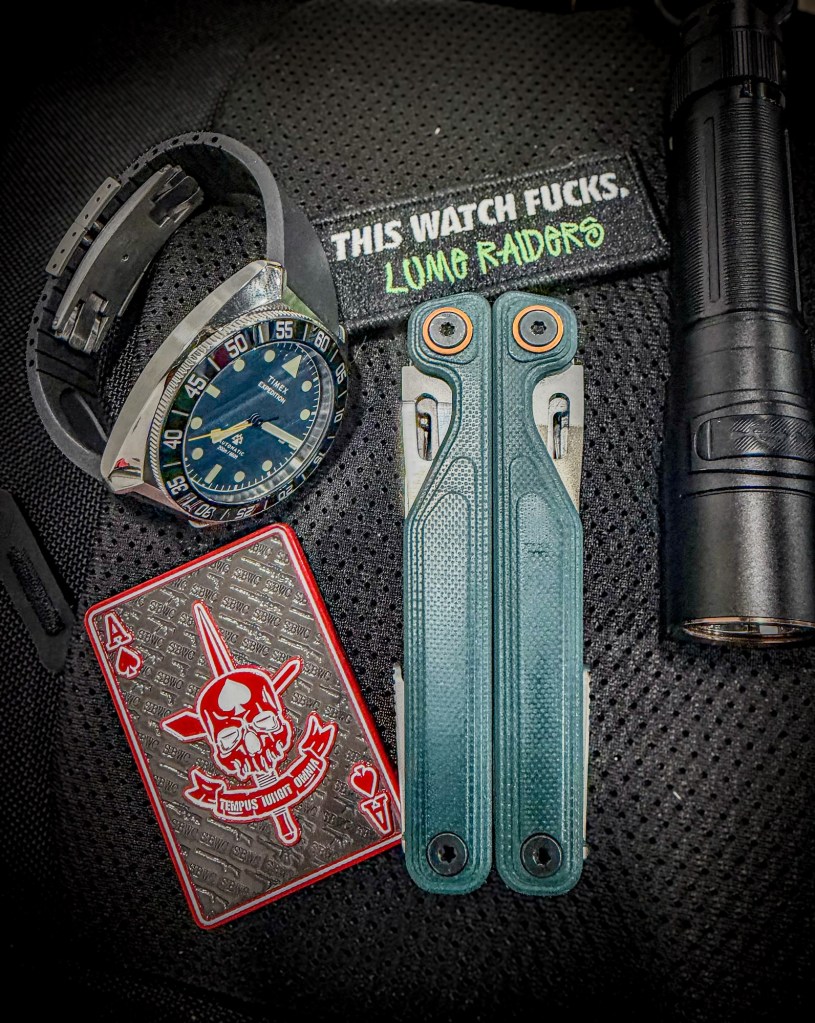
Timex Is Becoming More Interesting
For a long time, Timex occupied a pretty simple place in the watch world. It made inexpensive watches that were accessible, familiar, and easy to find.
That is clearly not the only space the company wants to occupy anymore.
I had multiple people notice the Meridian while I was out wearing it, and several were surprised when I told them it was a Timex. That reaction is interesting because it shows the gap between what people think Timex is and some of the watches Timex is actually making.
The Pioneer does the same thing from another direction. It takes the Expedition identity and gives it legitimate modern tool-watch specifications without simply turning it into another generic diver.
I like that.
I would rather see Timex experiment, push into these categories, and occasionally leave me with a few things to complain about than simply keep making the same safe watches forever.
But moving upmarket also changes the standard.
Once Timex starts asking $400, $500, and eventually more for watches, it is no longer enough to say, “Well, it is good for a Timex.” That is actually a shitty way to evaluate what the company is doing.
The watches need to be good for the money, period.
The Expedition Pioneer is.
The Deepwater Meridian GMT is close.
Why These Reviews Never Got Finished
Which brings me back to why these two final reviews kept sitting unfinished.
There just was not enough reason for me to keep stretching either one into its own article.
I had tested them. I knew what I liked. I knew what annoyed me. My opinions were not changing. Meanwhile, I had other watches, gear, stories, and ideas that I was more interested in writing about.
Eventually the fact that I kept pushing these reviews aside became part of the answer.
Not every piece of gear needs 1,500 words dedicated to it. Not every watch needs a massive final review simply because I started testing it. Sometimes the useful thing is to spend enough time with something to understand it, say what needs to be said, and move on.
The Pioneer is a good watch that I would still recommend at $429.
The Meridian is also a good watch, but at $549 I want Timex to finish refining the details before I can recommend it as easily.
Together, though, they leave me more interested in Timex than I was before I wore either of them.
Timex is not just making cheap watches anymore. They are making watches that deserve to be compared with the rest of the enthusiast market.
Now they just need to make sure every part of the watch is ready for that comparison.


Leave a comment